

Overview
The thyroid gland helps control a dog’s metabolic pace. It produces thyroxine (T4), which influences energy, weight, skin and coat quality, and body temperature. The pituitary gland releases thyroid-stimulating hormone (TSH) to tell the thyroid how hard to work. When thyroid hormone drops, TSH often rises as the body tries to compensate. Because many illnesses and some medications can temporarily change thyroid values, results are best interpreted together.
What do cT4, fT4 and cTSH tell you?
cT4 (total T4) measures both protein-bound and free hormone in blood. It is commonly used as a first screen. A clearly normal total T4 (especially mid to high within the reference interval) usually makes hypothyroidism unlikely. A low total T4 can occur in true hypothyroidism, but it can also be seen with non-thyroid illness (often called euthyroid sick syndrome) or after certain drugs such as glucocorticoids, so it is suspicious rather than diagnostic by itself.
fT4 (free T4) measures the small fraction of T4 that is not bound to proteins and is biologically active. Free T4 can add clarity when total T4 is low or borderline, because it can be less influenced by some non-thyroid conditions.
cTSH reflects the pituitary “signal” to the thyroid. High TSH together with low T4 supports primary hypothyroidism. However, TSH can still be within the reference interval in a meaningful portion of hypothyroid dogs, so it should not be used as a stand-alone rule-out test.
Overview
The thyroid gland helps control a dog’s metabolic pace. It produces thyroxine (T4), which influences energy, weight, skin and coat quality, and body temperature. The pituitary gland releases thyroid-stimulating hormone (TSH) to tell the thyroid how hard to work. When thyroid hormone drops, TSH often rises as the body tries to compensate. Because many illnesses and some medications can temporarily change thyroid values, results are best interpreted together.
What do cT4, fT4 and cTSH tell you?
cT4 (total T4) measures both protein-bound and free hormone in blood. It is commonly used as a first screen. A clearly normal total T4 (especially mid to high within the reference interval) usually makes hypothyroidism unlikely. A low total T4 can occur in true hypothyroidism, but it can also be seen with non-thyroid illness (often called euthyroid sick syndrome) or after certain drugs such as glucocorticoids, so it is suspicious rather than diagnostic by itself.
fT4 (free T4) measures the small fraction of T4 that is not bound to proteins and is biologically active. Free T4 can add clarity when total T4 is low or borderline, because it can be less influenced by some non-thyroid conditions.
cTSH reflects the pituitary “signal” to the thyroid. High TSH together with low T4 supports primary hypothyroidism. However, TSH can still be within the reference interval in a meaningful portion of hypothyroid dogs, so it should not be used as a stand-alone rule-out test.
When should a dog be tested?
Testing is considered when a dog has compatible signs such as low energy, unexplained weight gain, cold intolerance, a dry or thinning coat, recurrent skin or ear issues, or high cholesterol on routine bloodwork. Senior dogs and predisposed breeds may benefit from periodic screening too. Thyroid testing can also be useful before starting long-term therapy, and when monitoring response to levothyroxine in dogs already diagnosed.
Why use FIA for these hormones?
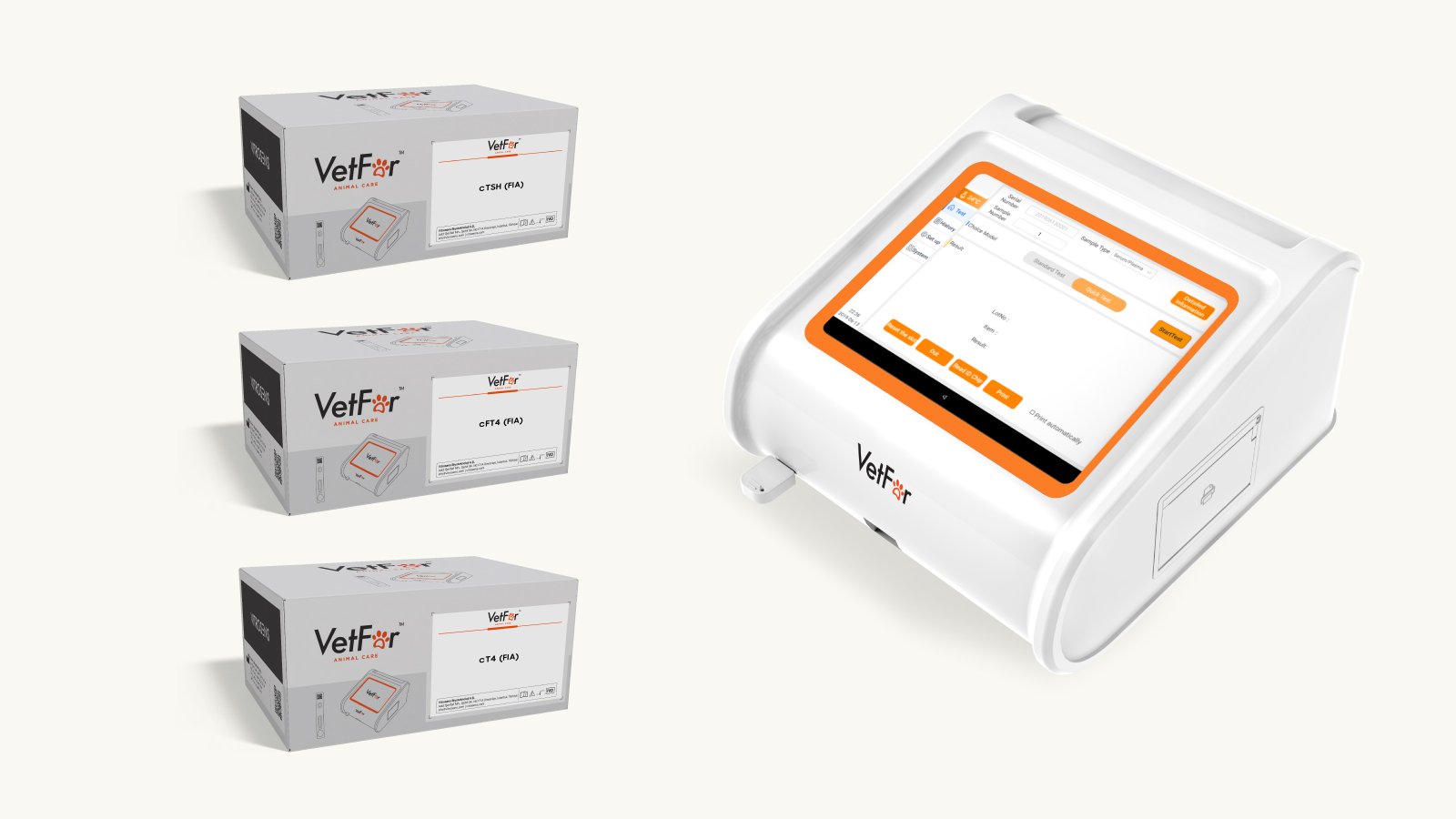
Fluorescence immunoassay (FIA) is an antibody-based method where a fluorescent label generates a measurable signal that an analyzer converts into a quantitative result. In practice, FIA supports objective readings, small sample volumes, and fast turnaround, which is helpful for in-clinic decision making and follow-up. Used together, cT4 (FIA), fT4 (FIA), and cTSH (FIA) provide a balanced view of the thyroid axis.
How veterinarians interpret patterns
A classic hypothyroid pattern is low cT4 plus low fT4, with cTSH above the reference interval. If only cT4 is low but fT4 and cTSH are not supportive, your veterinarian may consider concurrent disease, recent medications, stress, or repeating the test after recovery. Reference intervals can differ by method, so results should always be interpreted with the dog’s history, physical exam, and other lab findings.
References
- AAHA Selected Endocrinopathies Guidelines – Canine hypothyroidism diagnostic testing and monitoring.
- AAHA resource – Interpretive guidelines for thyroid testing (TT4, fT4, TSH).
- Cornell University AHDC – Thyroid testing interpretation (dog).
- VCA Animal Hospitals – Thyroid hormone testing in dogs.
- Merck Veterinary Manual – Hypothyroidism in animals (dogs).
- Radha et al., 2021 (PMC) – Fluorescent immunoassays: detection principles and labels.